Mentored Research
Engage in hands-on research across three required research practica, working closely with faculty mentors on funded projects, publications, and empirical studies.
World-class faculty mentoring with full tuition and stipends.
At a Glance
Format: In-Person
Duration: 5 Years (2 years coursework, 3 years dissertation)
Best Fit: Scholars and researchers committed to advancing social work science, social welfare policy, and interdisciplinary inquiry through rigorous empirical study.
Ranked #2 nationally, the WashU Brown School PhD in Social Work program pairs rigorous, empirical research with advanced interdisciplinary training. Our distinctive curriculum encourages students to collaborate across fields, master complex methodologies, and address structural inequities through transformative scholarship. Doctoral scholars gain hands-on experience through mentored research and teaching practica while receiving full tuition remission and annual stipends, including opportunities through our NIH-funded T32 predoctoral training programs that build on decades of national leadership in mental health and addictions research.
Backed by a century of leadership in social work, Brown School doctoral graduates enter the field equipped to lead academic research, shape public policy, and drive change, joining a global network of scholars and changemakers advancing social justice worldwide.
For the upcoming 2027 cohort, The Brown School PhD program will be prioritizing applicants for the two NIH T32 programs (See details below). Only U.S. citizens or permanent residents are eligible for these two training programs. The NIMH T32 is for applicants interested in mental health services research, behavioral health, or implementation science. The NIDA T32 is for applicants interested in addiction research. For information about the programs and application process see T32 Fellowship.
The curriculum at the Brown School emphasizes substantive, theoretical and methodological preparation. Our program requires 53 total credits earned through coursework and mentored research and teaching experience.
Your first year of study includes basic principles in research, statistics and measurement, as well as theoretical study and content to strengthen your social science knowledge-base. Your second year offers a more individualized program of study that is expanded to include a host of electives offered throughout the university. Students can also choose to declare one of the doctoral concentrations, and those required courses can be applied to the credit total as electives. A curriculum plan is developed by each student and an advisor/mentoring team, focusing on an area of specialization. Following two years of coursework, an additional two years is reserved for work related to the dissertation.
Brown School PhD students typically develop an individualized research area through coursework and mentored training opportunities
The Dissemination and Implementation Sciences (D&I) doctoral concentration provides an opportunity for students interested in the transdisciplinary field to complete relevant coursework and mentored research.
The Systems Science for Health Equity (SS4HE) doctoral concentration provides an opportunity for students interested in the transdisciplinary field to complete relevant coursework and mentored research. The concentration aims to prepare next-generation public health and social work scholars in complex systems thinking and methods.
Our doctoral program provides the nation and the world with some of the profession’s best scholars, teachers and researchers, and as such, is highly competitive. We review all applications holistically, assessing an individual’s overall preparation for rigorous doctoral study.
Applicants to the PhD in Social Work must have a master’s degree in social work or related discipline. Applications are accepted through our online application system. The application deadline is December 1.

We are committed to fully investing in our doctoral scholars. Every admitted full-time student receives a guaranteed, comprehensive funding package that includes full-tuition remission, dedicated professional development accounts, and a multi-year base living stipend of at least $37,853 annually for the first five years.
Beyond standard funding, eligible doctoral students have direct pathways to prestigious, NIH-funded predoctoral training fellowships through our National Institute of Mental Health (NIMH) and National Institute on Drug Abuse (NIDA) T32 programs. These elite appointments provide three years of specialized tuition support, enhanced stipends, and advanced mentorship for scholars focused on mental health services and addictions research.
The PhD curriculum includes three units each of required teaching and research practica. These practica occur after the first semester in our program and round out the individualized curriculum plan. Additional opportunities for research development are available within specific research fellowship programs, faculty laboratories and research centers.
Engage in hands-on research across three required research practica, working closely with faculty mentors on funded projects, publications, and empirical studies.

Build your pedagogical expertise through three teaching practicums, gaining direct classroom experience, syllabus design training, and mentorship as an educator.

Integrate advanced methodological training and specialized research labs directly into your practical work, preparing you for academic leadership.

Partner with renowned research centers, institutes, and faculty across WashU to address complex social problems through collaborative inquiry.
Partner directly with leading faculty mentors from day one, starting with your program director and transitioning to specialized advisors who guide your research and career.

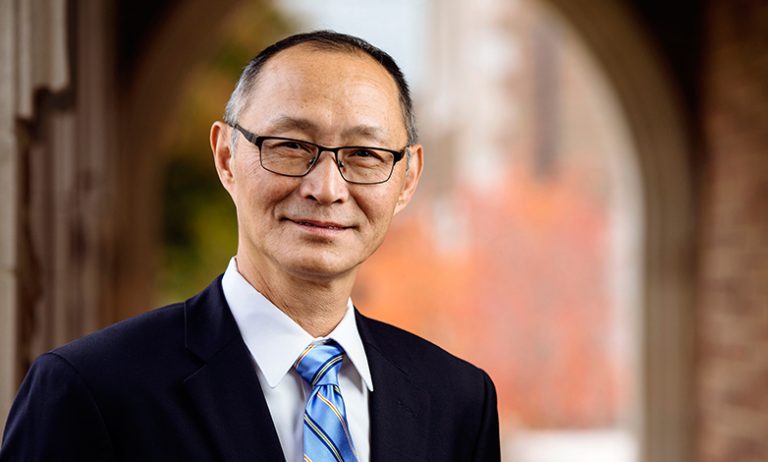
Shenyang Guo, PhD
Frank J Bruno Distinguished Professor of Social Work Research
Director, PhD Program in Social Work